
Luxembourg Soparfi Structure in Europe: Tax & Capital Planning Guide
This article explains general principles and is for information only. It does not constitute legal or tax advice. Personal outcomes depend on residence, income type, cross-border links, documents, and timing.
You have multiple income streams, an operating business in one or more European countries, and you are thinking about systematically protecting your family wealth? You have likely reached a stage where direct asset ownership is no longer efficient or secure. Establishing a family holding company is a logical step to consolidate assets, and now is the ideal time to choose the right structure.
For a European resident with international assets or a cross-border business, the structure combining a Luxembourg family office (Soparfi) and a local operating company is one of the most effective and lawful methods to protect capital, optimize taxation, and prepare for inheritance.
Why Luxembourg is Becoming the Top Choice in Europe?
For European investors, Luxembourg offers a unique combination of factors that are hard to find in other jurisdictions:
- Political and economic stability in the heart of Europe.
- Flexible corporate law: A Soparfi is not a separate company type but a tax status for holdings that can be applied to any Luxembourg company (most commonly an S.à r.l. or S.A.). This allows the structure to be adapted to any specific need.
- Developed professional infrastructure: The country hosts leading European banks, law firms, and audit companies with decades of experience handling international structures.
- "White list" reputation: Luxembourg is not considered an "offshore" or low-tax jurisdiction in the eyes of EU tax authorities. This is critical as it significantly reduces the risk of accusations of aggressive tax avoidance and the application of CFC (Controlled Foreign Companies) rules.
What is a Soparfi in Simple Terms?
A Soparfi (Société de Participations Financières) is a Luxembourg company created with one primary purpose: to hold shares in other companies (subsidiaries) and manage these investments. However, its function is broader than just holding shares. A Soparfi can also:
- Finance the group companies (provide loans).
- Manage intellectual property.
- Hold real estate (through separate structures).
- Accumulate profits for reinvestment.
Key feature: Under certain conditions, a Soparfi benefits from an exemption from tax on dividends and capital gains arising from the sale of its subsidiaries.
What Does the Classic European Structure Look Like?
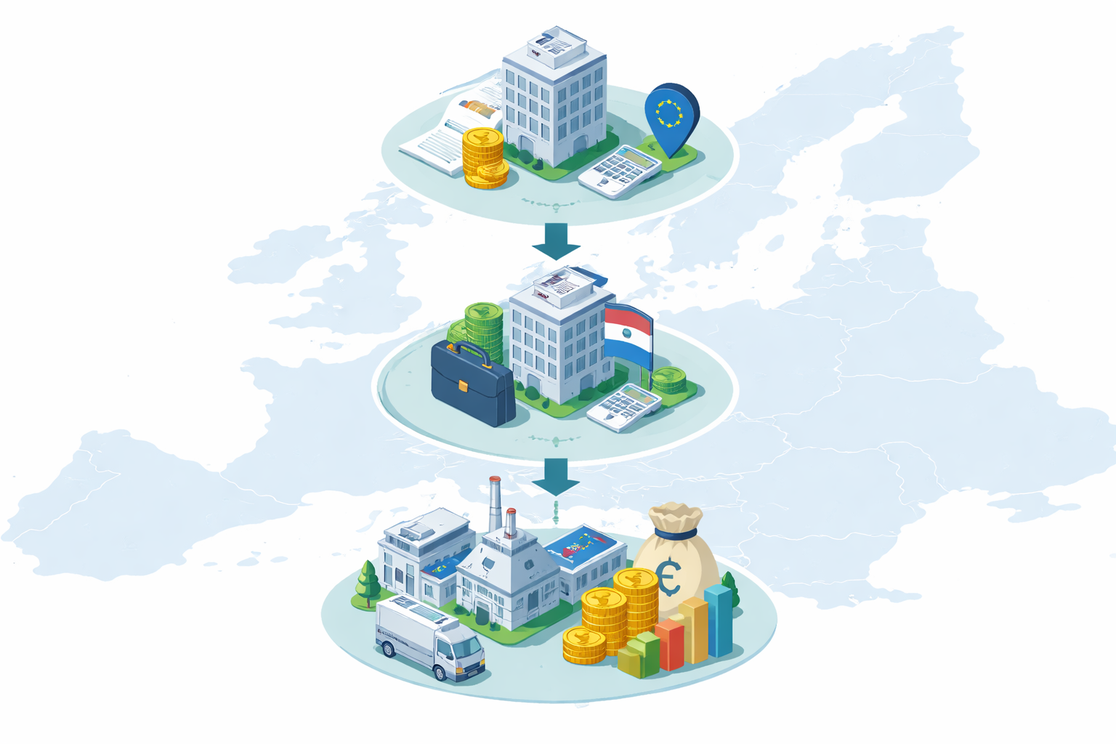
Structural Overview
EU Resident
Direct or structured ownership
Holding Company
Centralizes EU participations
Local Business Activity
Dividends & Reinvestment
How it works:
- You (as an EU resident) establish a Luxembourg holding company.
- The Luxembourg holding company establishes or acquires a stake in your existing operating company (e.g., a local manufacturing business).
- The operating company continues its business in its home country, paying all local taxes (corporate tax, VAT, etc.).
- The subsidiary's net profit can be distributed to Luxembourg as dividends.
- Thanks to EU directives, these dividends leave the source country without withholding tax (0%) and are also received tax-free in Luxembourg (under the participation exemption regime).
- The profit accumulated within the Soparfi can be further deployed: reinvested in new projects, used to acquire assets, or distributed to the owner at a later, potentially more tax-efficient, time.
Detailed Tax Advantages for EU Residents
A. Dividend Exemption (Mother-Subsidiary Directive)
This is the foundation of European tax planning. The EU Directive ensures that profit earned in one member state is not taxed again when transferred to a parent company in another member state. Standard EU conditions:
- Holding at least 10% of the subsidiary's capital (or an investment of at least €1.2 million).
- A minimum holding period of 1-2 years (depending on national law, but a commitment to hold the shares is often sufficient).
- Both companies are EU residents and subject to corporate tax.
B. Capital Gains Exemption (Participation Exemption)
If you decide to sell your successful business in the future, the sale of the subsidiary's shares by the Luxembourg holding company will, in most cases, not trigger capital gains tax in Luxembourg. This allows you to reinvest the entire sale proceeds.
C. Tax Deferral for the Owner (Deferred Taxation)
This is one of the main advantages for wealthy families. As long as profits remain within the Soparfi and are not distributed to you as dividends, you do not pay personal income tax or social contributions in your country of residence. The capital works within the corporate structure, accumulating faster. Important caveat: Many EU countries (Germany, France, Italy, Spain) have CFC rules. To avoid immediate taxation of undistributed profits, the Luxembourg company must have real economic substance (office, staff, risks) and not be a mere "shell" for passive income.
D. Inheritance Tax and Business Succession
Luxembourg law allows for flexible capital structuring through the issuance of different share classes. You can transfer "economic" shares (carrying dividend rights) to your heirs while retaining "management" shares (with voting rights). This allows for a phased transfer of wealth without losing control of the business and without needing to fragment the operating company. Furthermore, heirs receive dividends from the Soparfi, simplifying cash flow management compared to direct ownership of the operating company.
Critical: The Substance Requirements
For the structure to be valid and not considered artificial, the Luxembourg company must have real substance:
- A physical office in Luxembourg.
- A local director (or a professional management company) making key decisions.
- Employees performing management and control functions.
- A bank account and bookkeeping in Luxembourg.
- Directors' and shareholders' meetings held in Luxembourg with proper minutes.
If the Soparfi is merely a "mailbox," the tax authority in your country of residence could apply CFC rules and assess taxes as if the profits were earned by you personally.
Why Luxembourg and not the Netherlands, Cyprus, or Malta?
- The Netherlands: While historically popular, they are now introducing withholding tax on dividends in certain structures and tightening requirements.
- Cyprus / Malta: Although EU members, their tax regimes are often perceived as "aggressive" by the tax authorities of larger EU countries (Germany, France). This increases the risk of tax audits and disputes.
- Luxembourg offers the "sweet spot": prestige, predictability, a developed infrastructure, and tax advantages that are recognized at the European level without the negative reputation of a "tax haven."
Step-by-Step Plan to Establish the Structure
- Assemble a team of professionals:
- A tax advisor in your country of residence to analyze personal risks (CFC, wealth tax, if applicable).
- A Luxembourg lawyer to handle company incorporation and draft the articles of association.
- Auditors to assist with establishing substance and transfer pricing.
- Structure the ownership: Will you own the Soparfi directly or through a trust/foundation for confidentiality and asset protection purposes?
- Business plan for the Soparfi: Describe the specific activities of the holding company (managing participations, financing, consulting for subsidiaries). This is the foundation for demonstrating substance.
- Incorporation: Opening a bank account (often the longest step), notarizing the articles of association, and registering with the trade register (RCS).
- Business integration: Transferring the shares of your current operating company to the Soparfi. It is crucial to correctly assess the tax implications of this transfer in your home country.
Risks and Precautions
- Transfer Pricing: Any transactions between the Soparfi and its subsidiary (loans, services) must be at arm's length. Document everything.
- GAAR (General Anti-Abuse Rules): European courts and tax authorities are increasingly targeting purely artificial arrangements. Your structure must have commercial, not just tax, reasons for existing.
- Reporting in your country of residence:
- You are generally required to declare foreign bank accounts.
- If you own more than 10% of a foreign company, many EU countries require filing separate reports on its income.
- Ignoring these requirements leads directly to penalties, even if the structure itself is lawful.
Conclusion: Is This Structure Right for You?
The "Luxembourg Soparfi → EU Operating Company" model is a completely legal and reputable capital management tool used by many European families.
It is justified if:
- Your business generates stable profits (from several hundred thousand euros per year).
- You have plans to reinvest or accumulate capital within the group.
- You are thinking about asset protection and business succession planning.
- You are prepared to bear the annual costs of maintaining real substance in Luxembourg.
However, this is a complex structure. It requires professional advice and does not tolerate a superficial approach. Your next step is to meet with a tax lawyer in your country and a Luxembourg advisor to calculate the cost-effectiveness for your specific situation.
Frequently Asked Questions (FAQ)
What is the minimum capital required to set up a Soparfi?
The minimum share capital for an S.à r.l. (the most common form) is €12,000. However, to give the structure credibility and meet substance requirements, significantly higher assets or profits are generally recommended.
Does a Soparfi have to pay tax in Luxembourg if it does not distribute profits?
A Soparfi is subject to corporate income tax (CIT) in Luxembourg at the standard rate (around 24-25% depending on the municipality). However, if the company meets the participation exemption criteria, received dividends and capital gains may be exempt from tax. Any trading or consultancy activities carried out by the holding company itself would be taxable.
How often do I need to report to the tax authorities in my country of residence?
This depends on national legislation. It typically requires an annual declaration of foreign accounts and, if you hold more than 10% of a foreign company's capital, providing consolidated reports on that company's income (e.g., Form 3917-3918 in France or equivalent forms in Germany, Italy, Spain).
Articles and calculators rely on general assumptions. Your outcome depends on your specific circumstances. Richys structures your situation to define a clear position. A verified EU expert can provide a written conclusion.
Start case analysis
Julien Legaro
AI assistant – Contracts & Legal