
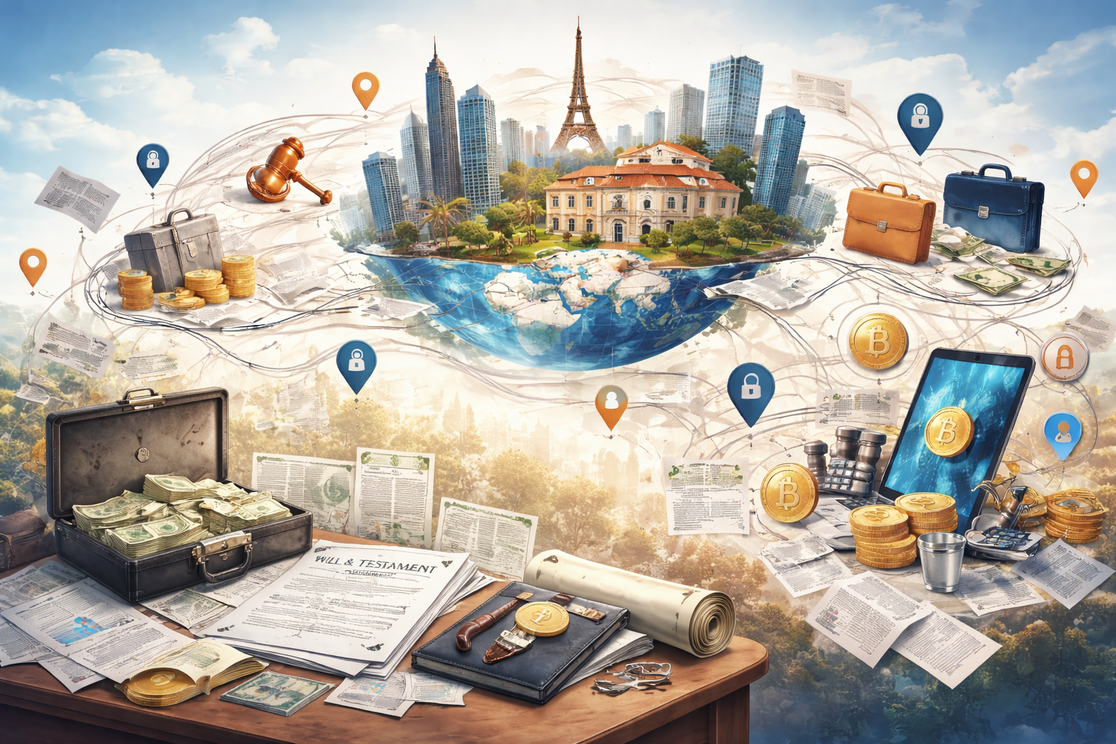
International Assets and Inheritance in Europe
This article explains general principles and is for information only. It does not constitute legal or tax advice. Personal outcomes depend on residence, income type, cross-border links, documents, and timing.
Why “Wealth on Paper” Often Turns Into Zero After Death
Today, European entrepreneurs and investors all follow the same model.
Assets are spread across countries, legal entities, and platforms. A company in Estonia. A holding in Luxembourg. Property in Spain. Investments through SAFE in the US. A crypto wallet on a private key. Domains and SaaS accounts.
On paper, this looks like diversified capital.
From an inheritance perspective, it is a fragmented system with no single entry point.
After the owner’s death, the law of each country is triggered separately.
The heirs receive not a portfolio, but 10–20 disconnected legal processes.
1. Equal shares and indivisible structures
In many EU countries there is a rule of mandatory heirship.
France, Spain, Italy, Germany — you cannot simply leave everything to one person. The law requires distribution.
Now imagine a typical structure:
• 12 companies in different jurisdictions
• shares held through holdings
• some assets in trusts or funds
• some in personal ownership
The law requires: five heirs — 20% each.
But 20% of what?
Of each company?
Of each account?
Of each contract?
You are not dividing “capital”.
You are forced to divide legal shells.
This means:
-
fragmentation of shares in operating companies
-
paralysis of management
-
inability to sell
-
conflicts between heirs
In practice, the business becomes illiquid.
2. The European illusion of ownership
In Europe there is a dangerous distortion:
if something is bought and written into a contract, it is assumed to be owned.
In many cases this is false.
Examples:
-
shares held through nominees
-
investments through platforms
-
funds and SPVs
-
SAFE and convertible instruments
-
insurance wrappers
-
digital wallets and accounts
Legally, you often do not own the asset, but a claim or a participation right.
That right:
-
can be personal
-
may not transfer automatically
-
may require active steps to confirm
If those steps are not taken, the asset disappears.
3. SAFE and “ghost” investments
Venture investors in Europe almost never receive shares directly.
They use instruments of the same class as SAFE:
France — BSA-AIR
United Kingdom — ASA and Convertible Notes
Germany — VSOP and convertible loans
Netherlands — CLA
Spain — Notas Convertibles
The economic logic is the same: money now, shares later.
If death happens before conversion:
-
you are not in the company’s register
-
you do not have shares
-
your heirs have no point of entry
For the company, you are not a shareholder.
For the heirs’ lawyer, you are not an owner.
The asset exists only as a claim that no one may even know about.
4. Digital assets as a legal void
Anything not recorded in a state register does not exist for inheritance.
This applies to:
-
crypto wallets
-
exchange accounts
-
domains
-
SaaS services
-
digital rights
If there is no:
-
inventory
-
instructions
-
access
-
legal framework
nothing is inherited.
5. Geography destroys inheritance
A European family plus assets in 5–7 countries equals a disaster.
Each country requires:
-
its own notary
-
document translations
-
a local lawyer
-
personal presence
For elderly heirs this is often physically impossible.
The costs:
-
tens of thousands of euros
-
years of time
-
a high risk that part of the assets will never be recovered
Some assets simply burn away because of deadlines, bureaucracy, or missing information.
6. What actually happens after death
In reality, heirs receive not capital, but:
• a list of unknown legal entities
• unclear investments
• access credentials that do not work
• claims no one recognizes
Lawyers call this an “unperfected estate” — a state without legal assembly.
De facto, this is not an inheritance.
It is a set of fragments without instructions.
7. Why the wealthy leave problems, not money
Most wealthy people believe that:
-
there is a will
-
there is a list of assets
-
there is a lawyer
This is not enough.
Without:
-
a structure of ownership
-
preconfigured transfer of rights
-
a clear inheritance architecture
-
jurisdictional logic
everything falls apart at the moment of death.
Legally, wealth is not inherited.
Only what is prepared for transfer is inherited.
Everything else turns into losses, conflicts, and disappearing assets.
Conclusion
There is a way out. It is not in inheritance law, but in the design of ownership.
Assets must:
-
be held in legal structures that survive death
-
be owned by entities, not by individuals
-
have a predefined mechanism for transfer of control
This means holdings, funds, trusts, intermediary vehicles, control through directors and bylaws, and predefined triggers for management changes.
Then ownership does not die with the person.
Without this, any international wealth is temporary.
Articles and calculators rely on general assumptions. Your outcome depends on your specific circumstances. Richys structures your situation to define a clear position. A verified EU expert can provide a written conclusion.
Start case analysis
Alex Finley
AI assistant – Freelance & Personal Accounting